

Virtual learning has transformed the way students study, communicate, and collaborate with classmates. Instead of relying entirely on traditional classroom discussions or individual assignments, students can now participate in online activities that encourage teamwork, friendly competition, and active learning. Remote study groups are becoming a practical way to review difficult subjects, prepare for examinations, and share knowledge regardless of geographical distance. However, keeping everyone engaged during an online study session can sometimes be challenging, especially when students spend long periods looking at screens and listening to explanations. Interactive learning activities offer a useful way to make these sessions more enjoyable and productive.
Blooket is an educational platform that allows teachers and students to participate in game-based learning activities. With suitable question sets and organized sessions, study groups can turn ordinary revision into an interactive experience. Blooket codes help participants join specific live games when a host has created a session and provided the required access information. Rather than treating online studying as another routine video call, groups can use these activities to test their understanding, identify knowledge gaps, and encourage one another to improve. When combined with thoughtful planning and meaningful discussions, game-based activities can support a more engaging virtual learning environment.
The real value of this approach comes from balancing entertainment with educational objectives. Students should not focus exclusively on winning a game or collecting rewards. Instead, they should use each question as an opportunity to understand a concept, correct a mistake, and explain their reasoning. By establishing clear goals and choosing appropriate activities, remote study groups can create a learning routine that supports participation, accountability, and academic progress.
Understanding How Blooket Supports Remote Study Groups
Remote study groups bring together students who want to learn the same material without necessarily being in the same physical location. Participants might communicate through a video meeting, a group chat, or another online collaboration tool while working through a shared topic. Blooket can complement these arrangements by providing interactive quizzes that encourage students to recall information and apply what they have learned.
During a session, one participant can host a game and share the joining information with the other members. Students can then participate using compatible devices and an internet connection. The exact joining process and available game options depend on the platform’s current features and session settings. Blooket codes are associated with particular live games, so students should use the code supplied by their group’s host rather than assume that an old code will remain valid. This arrangement makes it possible to organize focused revision activities for mathematics, science, history, language learning, and other subjects.
The format is particularly useful for students who struggle to remain engaged during conventional revision sessions. Answering questions, seeing results, and discussing mistakes can introduce variety into an otherwise repetitive routine. Nevertheless, the platform works best when it complements reading, practice exercises, and explanations instead of replacing them. A successful study group uses interactive games to strengthen learning rather than treating gameplay as the entire learning process.
Why Interactive Learning Matters in Virtual Education
Online learning provides flexibility, but it can also create problems with concentration and participation. Students may become distracted by notifications, hesitate to ask questions, or feel disconnected from their classmates. In a traditional classroom, teachers can often recognize confusion through facial expressions and immediate responses. Remote groups need more deliberate ways to check understanding and encourage everyone to contribute.
Interactive quizzes provide a straightforward method of making participation visible. Students must respond to questions instead of passively listening to a discussion. Their answers can reveal which concepts they understand and which require additional explanation. When a group notices that several members struggle with the same question, it can pause the activity and review the relevant material together.
Friendly competition may also increase motivation, particularly when students enjoy working toward a shared objective. However, competition should remain supportive rather than intimidating. A student who answers incorrectly should feel comfortable explaining their reasoning and learning from the experience. Study groups that celebrate improvement, curiosity, and collaboration are more likely to create a positive learning atmosphere than groups that focus only on rankings.
How to Organize an Effective Online Study Session
A productive remote study session begins with a clear objective. Before choosing a game, members should agree on what they want to accomplish. For example, a group preparing for a biology examination might focus on cell structure, while a mathematics group could review algebraic equations. A specific objective helps the host select suitable questions and prevents the session from becoming an unfocused collection of activities.
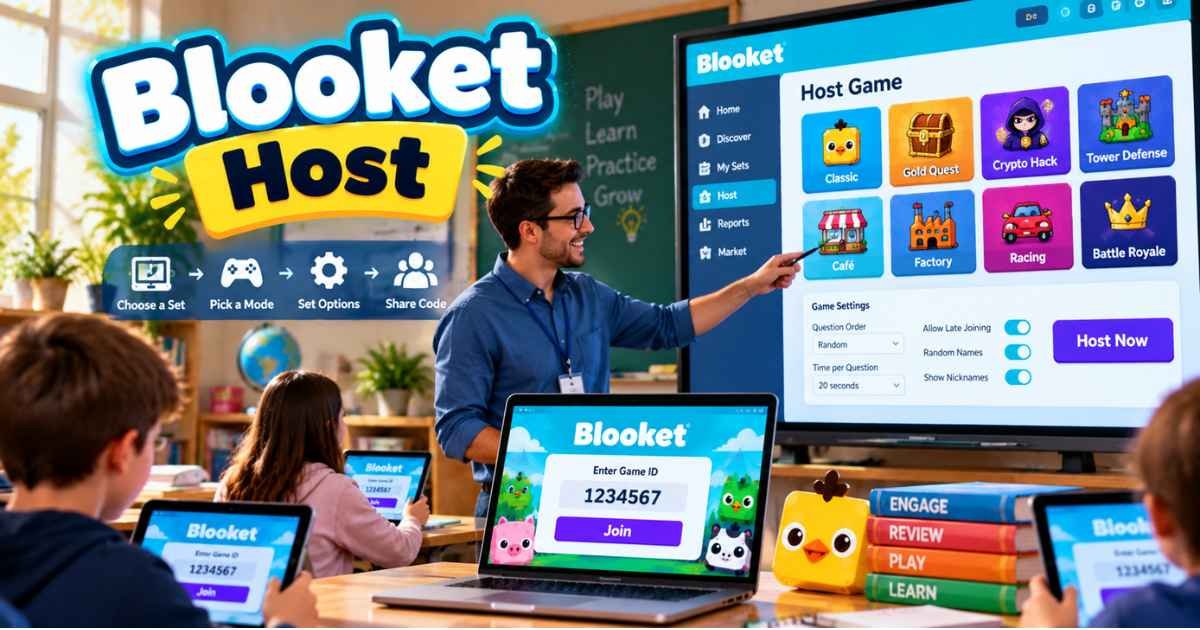
The host should prepare the relevant material, confirm that the participants can access the session, and explain how the activity will work. If the group uses blooket codes to enter a live game, the host should share the current code through the group’s agreed communication channel. Members should join promptly and ask for assistance if they encounter technical difficulties. It is also helpful to establish a backup plan, such as discussing prepared questions in the group chat if the game becomes unavailable.
A simple session structure can make online studying more manageable. The group might begin with a short review of previous material, continue with an interactive quiz, and finish by discussing difficult questions. This structure gives students time to activate their existing knowledge before testing themselves. It also ensures that the activity produces useful learning outcomes rather than ending immediately after the final score appears.
For example, four classmates studying chemistry could spend the first ten minutes reviewing chemical reactions, the next fifteen minutes answering related questions, and the final fifteen minutes explaining incorrect answers. Each student could take responsibility for explaining one concept. Such a routine combines individual recall with collaborative learning and helps the group identify what to study before its next meeting.
Best Ways to Use Blooket Codes for Collaborative Learning
1. Create Subject-Specific Revision Sessions
One effective approach is to organize separate sessions around individual subjects or topics. Instead of combining unrelated questions, the host can select a question set that matches the group’s current learning goals. A focused activity makes it easier to recognize patterns in mistakes and determine whether students understand the main concepts.
For example, students preparing for a history test could answer questions about important events, historical figures, and timelines. After the game, the group could discuss why particular events occurred and how they influenced later developments. This additional discussion turns memorization into a more meaningful examination of the subject.
2. Encourage Students to Explain Their Answers
Correct answers are useful, but understanding the reasoning behind them is even more important. After selected questions, the host can invite a participant to explain why an answer is correct. Other students can contribute alternative explanations, ask questions, or provide examples from their notes.
This technique encourages active participation and helps learners develop confidence in communicating their knowledge. It also gives the group an opportunity to correct misconceptions before they become established habits. When students explain concepts in their own words, they may discover gaps in their understanding that were not obvious while reading a textbook.
3. Rotate the Role of Host
Allowing different members to host sessions can make a study group more balanced. Each participant can prepare questions, select relevant material, and guide the discussion. Rotating responsibilities also prevents one student from carrying the entire organizational burden.
Students who prepare activities must think carefully about the subject and identify the most important concepts. This preparation can itself become a learning exercise. The group should agree on a reasonable level of difficulty so that activities remain challenging without becoming discouraging for less confident participants.
4. Use Results to Plan Future Revision
A game should provide more than a temporary sense of achievement. After completing an activity, the group can identify the questions that caused the most confusion and use them to guide future revision. Students can record recurring mistakes, revisit their notes, and prepare additional practice questions for the next meeting.
This approach makes revision more targeted. Instead of spending equal time on every chapter, learners can devote additional attention to areas that require improvement. Over several sessions, the group can review earlier mistakes and check whether its understanding has become stronger.
A Practical Schedule for Remote Study Groups
A planned timetable helps students balance interactive activities with deeper study. The following example shows how a group might organize a 45-minute online session.
| Session stage | Suggested time | Main purpose |
|---|---|---|
| Welcome and goal setting | 5 minutes | Identify the topic and expected outcome |
| Quick concept review | 10 minutes | Refresh important information |
| Interactive quiz | 15 minutes | Test recall and understanding |
| Discussion of mistakes | 10 minutes | Explain difficult questions and correct misconceptions |
| Final recap | 5 minutes | Record progress and set the next goal |
This schedule is flexible and can be adjusted according to the subject, students’ ages, and the difficulty of the material. A group working through complex mathematical problems might need more time for explanations, while a language-learning group might benefit from shorter rounds with frequent vocabulary practice. The important principle is to reserve time for reviewing results rather than allowing the game to consume the entire session.
Students should also avoid making every meeting identical. Alternating quiz activities with collaborative problem-solving, short presentations, and individual practice can prevent boredom. A varied routine gives learners different opportunities to demonstrate their understanding and keeps the group focused on its academic goals.
Choosing Appropriate Questions for Different Subjects
The quality of an educational game depends heavily on the questions it contains. Questions should match the learners’ current level and reflect the material they need to understand. If the questions are too easy, participants may become disengaged. If they are excessively difficult or unrelated to the syllabus, students may become frustrated and struggle to identify what they should learn from the activity.

For mathematics, question sets can cover formulas, arithmetic operations, algebraic relationships, geometry, or probability. After answering, students can explain the steps used to reach a solution. A quiz may help them recognize a familiar formula, but solving longer problems independently remains important for developing mathematical reasoning.
Science groups can use questions about definitions, processes, diagrams, and cause-and-effect relationships. For languages, vocabulary, grammar, sentence structure, and reading comprehension can provide useful material. History and geography groups can review timelines, locations, events, and connections between different developments. In every subject, the group should select questions that encourage understanding rather than relying entirely on isolated facts.
When using blooket codes to access a study activity, participants should also confirm that the selected question set is appropriate for their learning objective. A popular game is not necessarily the best educational choice. Accuracy, relevance, and a suitable difficulty level should take priority over novelty.
Keeping Every Member Involved
One common problem in online study groups is unequal participation. Some students may answer almost every question, while others remain quiet or struggle to keep pace. The host can address this issue by establishing a respectful atmosphere and giving members different ways to contribute.
For example, students can take turns explaining answers, suggesting questions, or summarizing a chapter. The group can also agree that everyone will contribute at least one observation during the discussion. These responsibilities make participation more balanced without placing unnecessary pressure on individuals who need extra time to think.
A supportive environment is especially important when students make mistakes. Public criticism, sarcastic comments, or excessive attention to low scores can reduce confidence and discourage participation. Members should instead treat incorrect answers as opportunities to discover what needs further explanation. Celebrating steady improvement can be more useful than repeatedly recognizing only the highest-scoring player.
The group should also respect different learning speeds and accessibility needs. Some students may have slower internet connections, older devices, or limited opportunities to participate at particular times. Sharing the session plan in advance, allowing reasonable flexibility, and offering written summaries can help make the experience more inclusive.
Common Challenges and Practical Solutions
Although game-based learning can improve engagement, remote study groups may encounter technical and organizational difficulties. Internet interruptions, device compatibility, scheduling conflicts, and unclear responsibilities can interrupt a session. Groups can reduce these problems by checking access beforehand, agreeing on meeting times, and keeping their study materials organized.
Another challenge is excessive competition. Students may concentrate on answering quickly instead of understanding the question. To address this issue, the host can include discussion breaks, encourage explanations, and remind members that the main objective is learning. Scores should be treated as temporary feedback rather than a complete measure of academic ability.
Groups should also avoid spending too much time searching for codes or joining activities that are no longer available. A live-game code is generally connected to a particular session, so it may stop working when that session ends or its access conditions change. Participants should obtain joining information directly from the current host and follow the platform’s applicable rules.
Useful habits for managing these challenges include:
- Agree on one clear learning objective before each meeting.
- Check devices, internet access, and joining instructions in advance.
- Discuss difficult answers instead of focusing exclusively on scores.
- Keep a shared record of topics that need additional revision.
- End each meeting with a practical goal for the next session.
These straightforward practices can make virtual study meetings more consistent without requiring complicated planning or additional software.
Responsible and Balanced Use of Educational Games
Online educational platforms should be used with attention to privacy, appropriate conduct, and personal well-being. Students should follow their school’s rules, avoid sharing private information unnecessarily, and participate only in sessions they are authorized to join. Teachers and parents can help younger learners understand appropriate online behavior and recognize the importance of protecting personal details.
It is also sensible to balance screen-based activities with other forms of learning. Reading, handwritten notes, independent exercises, and verbal explanations remain valuable parts of education. A student who performs well in a timed quiz may still need practice writing a detailed answer or solving a complex problem without assistance. Different learning activities develop different skills, so a balanced routine is more effective than relying on a single platform.
Study groups should also take regular breaks when sessions become lengthy. Short breaks can help participants maintain concentration, especially during examination preparation. The group can decide in advance how long each activity should last and finish at a reasonable time. A sustainable schedule is more likely to support consistent progress than an intense routine that students cannot maintain.
Measuring Progress Beyond Game Scores
Game scores can provide an immediate indication of performance, but they should not be the only measure of success. Students should consider whether they can explain a concept without looking at the answer choices, solve a similar problem independently, or remember important information several days later. These checks provide a clearer picture of whether learning has actually taken place.
A shared progress record can help remote study groups monitor their development. After each meeting, members can note which topics they reviewed, which questions they found difficult, and what they plan to practise next. During the following session, the group can revisit a few earlier questions to determine whether its understanding has improved. This process encourages accountability while making revision more systematic.
Teachers and group leaders can also compare quiz results with homework performance, practice tests, and classroom participation where appropriate. If a student repeatedly struggles with a topic, the group can recommend additional explanations or individual practice rather than simply repeating the same game. The objective is to use feedback to guide learning decisions.
Ultimately, progress becomes more meaningful when students can apply what they have learned in new situations. A successful session should leave participants with a stronger understanding of the subject, greater confidence in their abilities, and a clearer idea of what they need to study next.
Conclusion
Remote study groups can make virtual education more engaging when they combine clear academic goals, supportive teamwork, and interactive activities. Blooket offers a way to introduce game-based revision into online meetings, giving students opportunities to test their knowledge, identify misunderstandings, and discuss challenging concepts with their peers. With suitable question sets and thoughtful session planning, these activities can bring variety to revision and encourage students to participate more actively.
The most effective approach is to treat games as one part of a broader learning strategy. Students should prepare in advance, take turns contributing, review incorrect answers, and measure progress through understanding rather than rankings alone. Reliable communication, respectful behavior, and realistic schedules also help remote groups remain organized and inclusive.