

Learning becomes more enjoyable when students can participate actively instead of simply reading textbooks or listening to explanations. Interactive educational games have become an important part of modern learning because they combine knowledge, competition, and entertainment in a single experience. Blooket is one platform that follows this approach by allowing teachers and students to engage with quiz-based activities through different game formats. Rather than treating every question as a traditional test, the platform introduces challenges that encourage learners to think quickly, remember information, and participate throughout a session.
Blooket Play represents the experience of joining and participating in these educational games. Students can answer questions, collect rewards within supported game modes, and compete with classmates while reviewing important concepts. Teachers can use the platform to make revision sessions more interesting, introduce new topics, or identify areas where students need additional support. The combination of familiar quiz questions and playful mechanics can make even repetitive practice feel more engaging when activities are designed around clear learning objectives.
However, the value of an educational game depends on more than its entertainment factor. Students need understandable questions, suitable difficulty levels, and opportunities to learn from incorrect answers. Teachers also need to ensure that competition remains friendly and that students focus on understanding the material rather than simply achieving the highest score. When used thoughtfully, Blooket can support these goals and create a more interactive classroom experience.
What Is Blooket Play?
Blooket is an educational gaming platform that transforms question-and-answer activities into interactive experiences. Teachers can prepare question sets or select suitable existing material, then use supported game modes to help students practise a subject. The questions may cover mathematics, science, vocabulary, history, geography, language learning, and many other academic topics. Students participate by answering questions and engaging with the mechanics of the selected game mode.
The main idea behind Blooket Play is to connect academic practice with activities that feel entertaining. In a conventional worksheet, students generally move from one question to another without much variation. A game-based activity can introduce goals, progress, rewards, and friendly competition that encourage students to remain involved. For example, a teacher reviewing multiplication tables might use a short quiz session to help students practise calculations while maintaining their interest. The questions remain educational, but the presentation makes the activity feel different from an ordinary assignment.
The platform is useful for different learning environments, including classrooms, supervised group activities, and individual revision where the selected mode supports it. Its effectiveness depends on the quality of the questions and how the activity fits into the lesson. A well-designed game can reinforce concepts that students have already studied, while a poorly matched activity may distract them from the intended learning outcome.
How Blooket Play Works
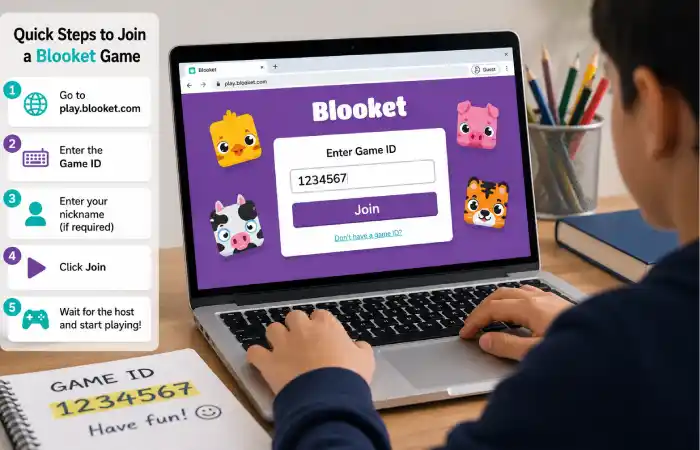
The experience generally begins with a teacher or host selecting a question set and choosing an available game mode. The host then starts a session and provides the appropriate joining information to participants. Depending on the activity and the platform’s current options, students can enter the game using the displayed session details and follow the instructions shown on their devices. The host controls the session, while participants answer questions and interact with the game.
Once the activity begins, students respond to questions and may earn points or other in-game rewards according to the rules of the selected mode. Some modes emphasize speed, while others introduce additional objectives that influence how players progress. This variety allows teachers to choose an activity that matches their classroom goals. A vocabulary lesson, for instance, may benefit from repeated question practice, while a mathematics revision session might use a more competitive format to encourage quick recall.
After the session, teachers can review available results when reporting features are supported by the activity. These results may help identify common mistakes, difficult questions, or concepts that deserve another explanation. Students can also use the experience to recognize which subjects require further revision. The best approach is to treat the game as one part of a broader lesson rather than a replacement for explanation, discussion, and independent practice.
Popular Game Modes and Their Learning Benefits
One of the platform’s defining features is the range of game formats that can be used with educational questions. Different modes introduce different objectives, giving teachers flexibility when planning activities. Availability and features can change over time, so the options displayed in the current platform should be checked before preparing a lesson.
| Game mode | General experience | Potential learning benefit |
|---|---|---|
| Gold Quest | Players answer questions while pursuing in-game rewards. | Encourages participation and repeated practice. |
| Tower Defense | Correct answers support progress through a strategic challenge. | Combines question practice with planning. |
| Factory | Players work toward improving an in-game operation. | Encourages continued engagement with questions. |
| Cafe | Players answer questions while managing a virtual cafe. | Adds goals and resource management to revision. |
| Racing | Players compete through question-based progress. | Supports quick recall and active participation. |
These examples illustrate how a single collection of questions can support different classroom experiences. A teacher might use a strategy-based mode with students who enjoy planning, while a faster competitive mode may suit a short revision activity. The important consideration is whether the selected format reinforces the lesson instead of creating unnecessary complexity.
Choosing the Right Mode for Different Students
Not every student responds to competition in the same way. Some learners enjoy racing against classmates, while others feel more comfortable with activities that emphasize personal progress. Teachers should consider classroom dynamics, age groups, subject difficulty, and available lesson time when selecting a format. A short activity with straightforward rules may be more effective for introducing a new concept than a complex mode requiring students to learn several game mechanics.
Teachers can also rotate formats to prevent the experience from becoming repetitive. For example, a class might use one mode for vocabulary revision and another for a weekly mathematics review. Changing the format can maintain interest while keeping the underlying educational objective consistent. Students should understand that answering accurately and learning from mistakes are more important than winning every round.
Benefits of Using Blooket for Education
A major benefit of game-based learning is its ability to encourage participation. Students who hesitate to answer questions aloud may feel more comfortable responding through an interactive activity. Because participants can engage with questions individually, teachers may gain a broader picture of classroom understanding than they would from asking only a few volunteers. This does not guarantee that every student will participate equally, but it creates another opportunity for involvement.
Another advantage is repeated practice. Remembering facts, formulas, definitions, and vocabulary often requires students to encounter information more than once. Interactive quizzes can make this repetition feel less monotonous. A student learning fractions, for example, may answer several questions involving equivalent fractions, comparisons, and basic calculations during a session. Repeated exposure can help reinforce recall, particularly when incorrect answers are followed by explanations and additional practice.
The platform can also support motivation by introducing visible progress and achievable goals. Students may become more willing to attempt challenging questions when the activity provides immediate feedback or a clear sense of advancement. Teachers can use these features to create short review sessions before assessments, introduce friendly classroom challenges, or encourage learners to practise concepts they previously found difficult.
Nevertheless, game-based learning is most effective when it complements other teaching methods. Students still need detailed explanations, opportunities to ask questions, and time to apply their knowledge independently. A high score does not necessarily prove deep understanding, especially if students answer quickly without explaining their reasoning. Teachers should therefore connect game results with classroom discussion and other forms of assessment.
How Teachers Can Use Blooket Play Effectively
Teachers can use the platform at several points during a lesson. At the beginning, a short quiz can reveal what students already know about a topic. During instruction, selected questions can reinforce recently introduced concepts. At the end, a review activity can help learners recall important information and identify areas that need further explanation. This approach gives the game a clear educational purpose instead of using it simply to fill spare classroom time.
Question quality is particularly important. A useful question set should match the students’ age, current knowledge, and curriculum requirements. Questions should be written clearly, with answer choices that test understanding rather than confuse learners through unnecessary wording. Teachers should also review the accuracy of existing question sets before using them, because user-created educational material may contain mistakes, outdated information, or unsuitable content.
A practical preparation process can include the following steps:
- Define one clear learning objective for the session.
- Select or create questions that match the lesson.
- Choose a game mode appropriate for the students and available time.
- Review the results and explain important mistakes afterward.
This simple process helps teachers maintain a balance between enjoyment and academic progress. A ten-minute activity focused on one concept can be more valuable than a longer game containing unrelated questions. Teachers should also consider whether all students have access to a suitable device and reliable classroom connectivity before beginning.
Using Blooket for Different Subjects
Mathematics and Science
Mathematics lessons often involve practising procedures until students become comfortable applying them. Interactive quizzes can support multiplication, division, fractions, percentages, equations, and geometry vocabulary. A teacher might prepare questions that gradually increase in difficulty, allowing students to begin with basic calculations before moving to more demanding problems. Science teachers can use a similar structure for terminology, scientific processes, formulas, and concept review.
For these subjects, speed should not become the only measure of success. Some mathematical problems require careful reasoning, and science questions may involve concepts that students need time to understand. Teachers can pause after selected questions to explain why an answer is correct and discuss common misconceptions. This turns the activity into a learning opportunity rather than a simple race.
Language Learning and Vocabulary
Language teachers can use quiz-based games to practise spelling, grammar, word meanings, sentence structure, and reading comprehension. Students learning a new language may benefit from repeated exposure to vocabulary in short, manageable sessions. For example, a question set might ask students to identify synonyms, select the correct verb form, or match a word with its meaning.
Teachers can make these activities more useful by incorporating examples in context. Instead of testing isolated definitions alone, they can include sentences that demonstrate how words are used in everyday communication. After the game, students can write their own sentences using the vocabulary they reviewed. This additional step connects recognition with practical language production.
History, Geography, and General Knowledge
History and geography lessons frequently require students to remember names, dates, places, events, and relationships. A carefully prepared quiz can help learners review these details before a test or after completing a unit. Teachers might create questions about historical timelines, capital cities, physical features, important discoveries, or the causes and consequences of major events.
However, memorization should not replace deeper analysis. Students also need to understand why historical events occurred, how geographical conditions affect communities, and how different developments are connected. Teachers can use the game to introduce or reinforce factual knowledge, then follow it with discussion, written responses, maps, or short research activities that encourage deeper thinking.
Common Challenges and How to Address Them
Although interactive learning offers several advantages, it can create challenges when activities are not planned carefully. Competition may discourage students who consistently receive lower scores, while excitement can sometimes make it difficult to maintain classroom focus. Technical problems, unfamiliar rules, and differences in reading speed can also affect the experience. Recognizing these limitations allows teachers to prepare more inclusive activities.
One useful solution is to emphasize personal improvement rather than constant comparison with classmates. Teachers can celebrate progress, accuracy, teamwork, and persistence instead of focusing exclusively on rankings. They can also select shorter sessions, explain the rules before starting, and provide additional support to students who need it. When appropriate, cooperative activities may offer a more comfortable alternative to highly competitive formats.
Digital access and privacy deserve attention as well. Students should use the platform according to their school’s technology policies and follow their teacher’s instructions when joining a session. They should avoid sharing unnecessary personal information, using inappropriate display names, or entering details on unofficial pages that claim to provide access to games. Teachers and parents should review current platform policies and classroom requirements, especially when younger students are involved.
Tips for Students to Get More From Each Game
Students can improve their learning experience by focusing on the material instead of treating every activity as a competition. Reading each question carefully, considering the available answers, and reviewing mistakes can help develop stronger understanding. Guessing quickly may sometimes produce a higher score in a particular mode, but it does not always help students remember the subject afterward.

It is also useful to revisit questions that caused difficulty. If a student repeatedly struggles with fractions, grammar rules, or scientific terminology, those mistakes can guide the next revision session. Reviewing the relevant textbook section, asking the teacher for clarification, and practising similar questions can help address the underlying problem. Students should view incorrect answers as useful feedback rather than evidence that they cannot learn the topic.
A balanced routine works best. Short gaming sessions can support regular revision, while homework, reading, note-taking, and independent problem-solving provide additional depth. Students should follow classroom rules, respect other participants, and remember that the purpose of an educational game is to build knowledge. With this mindset, Blooket Play becomes a tool for learning rather than simply a way to pass time.
Conclusion
Blooket offers an engaging way to combine quiz questions with interactive game mechanics, making classroom revision more dynamic and enjoyable. Its different formats allow teachers to adapt activities to a variety of subjects, student preferences, and learning objectives. Whether students are practising mathematics, reviewing vocabulary, or remembering important historical facts, a well-designed game can encourage participation and provide another opportunity to reinforce knowledge.
The greatest value comes from thoughtful use. Teachers should select accurate questions, choose suitable game modes, explain difficult concepts, and use available results to guide future instruction. Students should concentrate on understanding the material, learning from mistakes, and improving their skills rather than focusing only on rankings. When combined with discussion, reading, and independent practice, Blooket Play can contribute to a balanced and interactive educational experience that supports both motivation and meaningful learning.